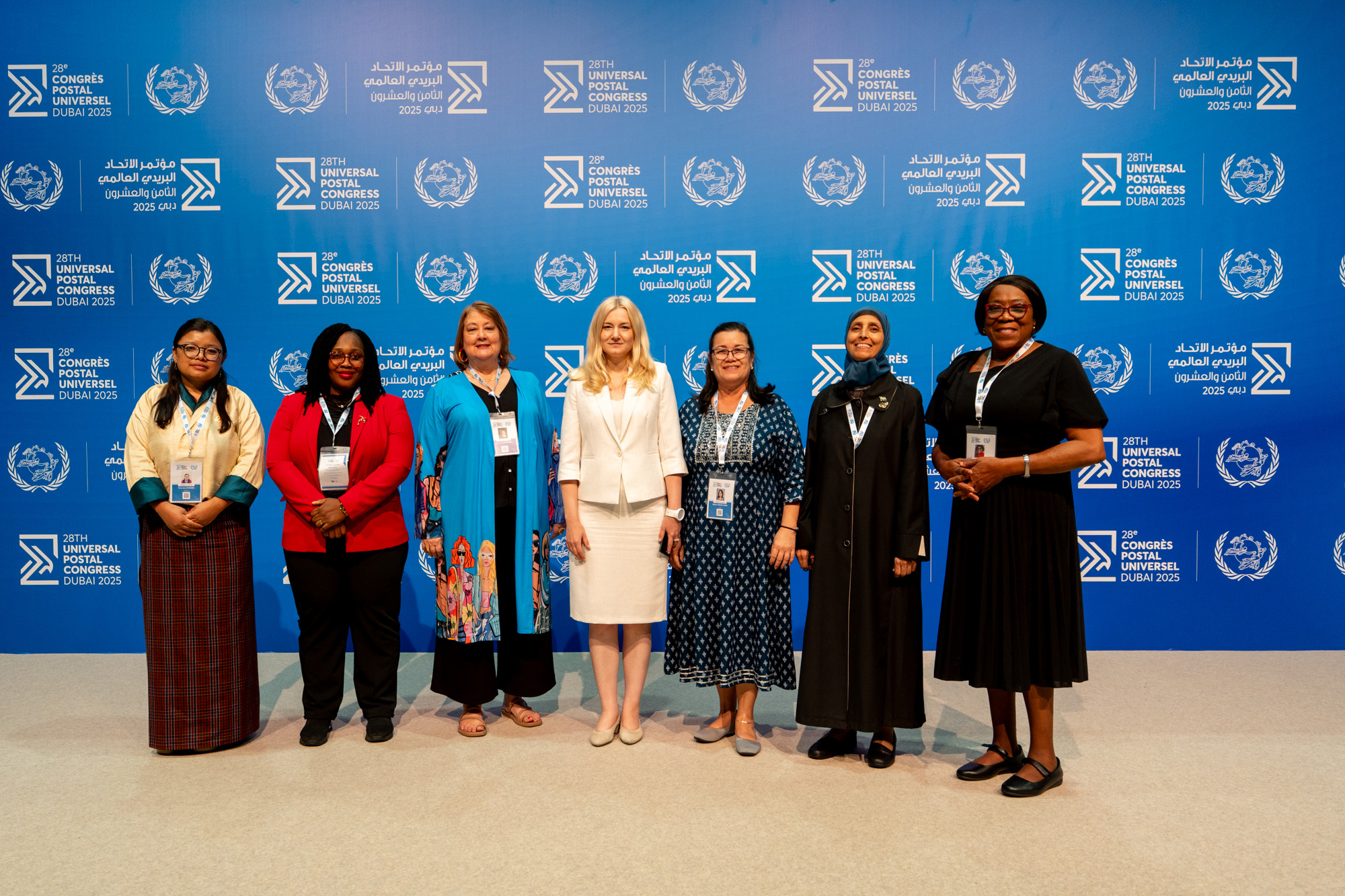
Since its launch in 2018, the UPU’s gender fellowship has continued to grow as a flagship initiative to empower women leaders in the postal sector. The programme translates the UPU’s gender equality and empowerment of women (GEEW) policy into its capacity-building work, offering women professionals international exposure, leadership development and direct engagement with the Union’s governing bodies.
By integrating this work into the UPU’s capacity development framework, the fellowship seeks to ensure that gender equality and women’s empowerment are addressed in parallel with the core business of the Union.
Congress edition: six leaders, six perspectives
At the 28th Universal Postal Congress, held in Dubai from 8 to 19 September 2025, the gender fellowship brought together six senior women leaders from across the UPU’s regional landscape to gain insights into the sector’s pressing challenges and opportunities during the first week of this event.
Representing five UPU regions (namely Africa, the Arab region, Asia-Pacific, Europe and CIS, and the Caribbean and Latin America), the participants were Rinchen Zangmo, Head of Corporate Services at Bhutan Postal Corporation; Meilam Weng Peña, Head of Postal Services at the Ministry of Communications of Cuba; Elise Koivogui, Deputy Director General of La Poste Guinéenne (Guinea); Racha Elikou, Director of Communications and Executive Support at the Syrian Post; Jacqueline Adams-Ollivierre, Director of Postal Services at Saint Vincent and the Grenadines Postal Corporation; and Violeta Cojocaru, Administrator of Posta Moldovei (Rep. of Moldova).
Funded entirely through voluntary contributions under the Development and Cooperation Directorate’s interregional training project, the fellowship was aimed at enabling the active participation of high-performing women leaders from Posts worldwide. By the end of their participation in the Congress, fellows were expected to have gained first-hand experience of the Union’s decision-making processes and expanded their professional networks through exchanges with delegates from across the global postal community.
The fellows’ week-long programme included participation in plenary and committee sessions, bilateral meetings with key stakeholders, media engagements and networking with ministers, regulators, postal CEOs and partners.
Reflecting on the experience, Jacqueline Adams-Ollivierre of Saint Vincent and the Grenadines Postal Corporation said that “being part of the Congress was a valuable opportunity to understand how decisions are shaped at global level and how international cooperation translates into real impact on the ground. Inclusion in such forums brings greater visibility – for women, for postal institutions and for their countries”.
Turning exposure into leadership
The Congress edition of the gender fellowship was designed not only to highlight women leaders, but also to equip them with practical insights to strengthen their work at home. For Rinchen Zangmo of Bhutan Postal Corporation, the experience reaffirmed that empathy and fairness are key to effective leadership in a customer-centred postal environment.
From Guinea, Elise Koivogui described the Congress as “a true catalyst” that helped create new strategic connections and inspired her to pursue a stronger and more modern African postal network. Racha Elikou from the Syrian Post saw the fellowship as a bridge for renewed collaboration. “The UPU provides an important platform for learning from others’ experiences [and] building strategic partnerships that strengthen postal services and the industry as a whole,” she said.
For Meilam Weng Peña, from the Cuban Ministry of Communications, exchanges with peers underscored how empowering women across all levels can drive operational excellence and innovation. And Violeta Cojocaru of Posta Moldovei noted that, with more than 87% of staff being women, the Moldovan Post exemplifies how gender balance contributes to decision-making and organizational strength.
Impact: ensuring sustainability and scaling up
Since 2018, the gender fellowship has steadily expanded, building a wider community of women leaders who remain engaged with UPU activities. Many former fellows have progressed into more senior positions, launched mentoring schemes and championed initiatives to embed gender equality within their organizations.
These success stories demonstrate the multiplier effect of investing in women’s leadership. By aligning the fellowship with the UPU’s broader capacity development strategy, the programme ensures that empowerment is institutionally anchored and delivers tangible benefits to member countries.
It should be emphasized that all fellowship editions to date have been financed through voluntary contributions. Sustaining and expanding the initiative in the new cycle will require continued support from member countries and partners. Targeted resource mobilization will therefore remain a priority.
Complementing the fellowship, the UPU launched a Trainpost course in March 2025 in partnership with the International Training Centre of ILO (ITCILO) on gender mainstreaming and women’s empowerment in the postal sector to reinforce these efforts. More than 160 postal professionals from 54 countries have already completed the course, which will be translated into all official UPU languages by 2026 to extend its global reach.
As the UPU prepares its next capacity development cycle, women’s empowerment will remain one of its focuses alongside other core technical pillars. The gender fellowship – including future Congress and Council editions – will continue to serve as a catalyst for change, equipping women leaders to shape a more inclusive, innovative and sustainable postal sector.
This article first appeared in Union Postale Autumn 2025.