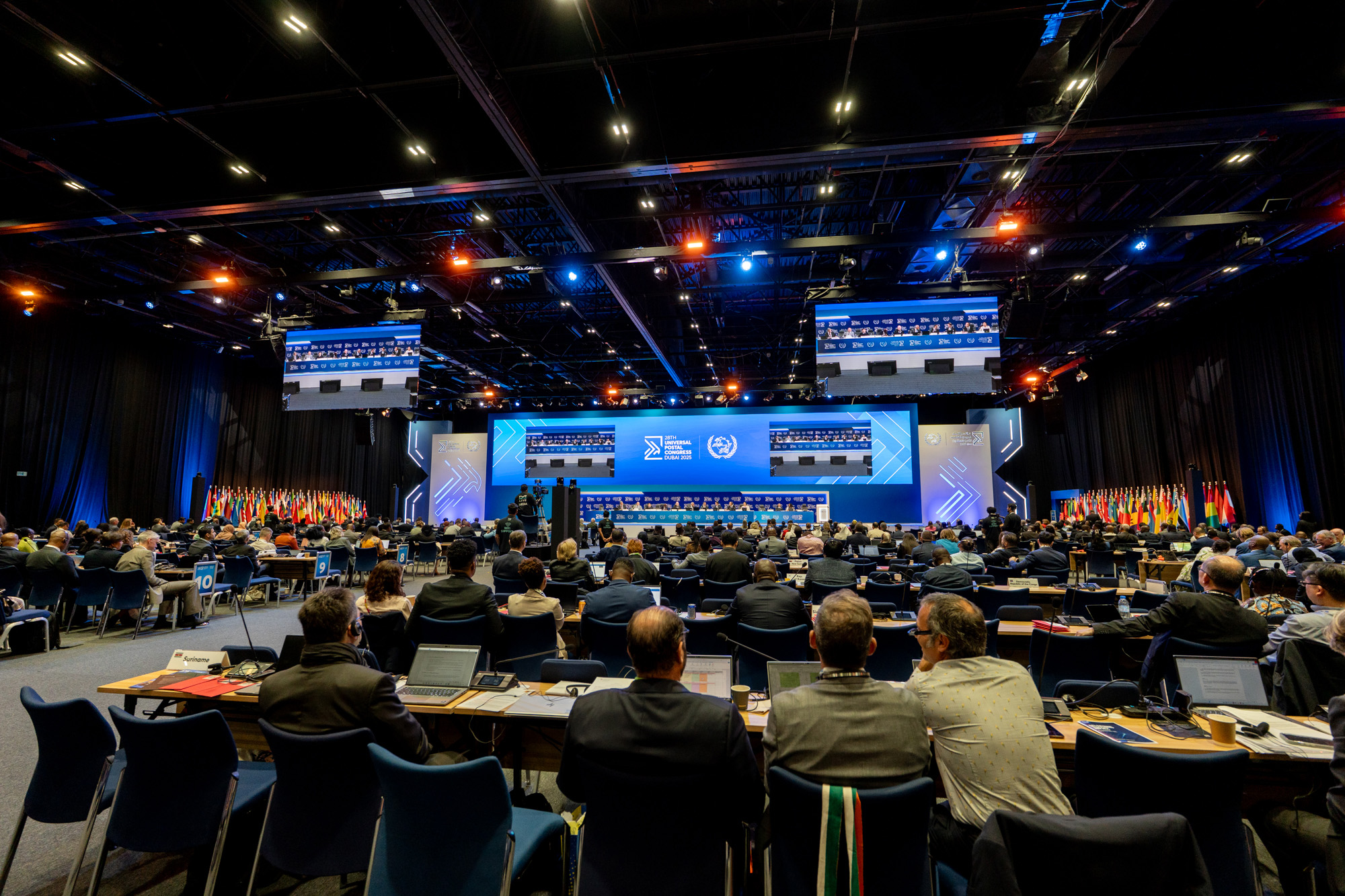
Following the 28th Universal Postal Congress in Dubai, the UPU has a clear and future-focused plan to reinvigorate postal services for the years to come.
Representatives from UPU member countries gathered in Dubai, United Arab Emirates, over the course of two weeks during the 28th Universal Postal Congress to decide the future of the UN specialized organization and the postal network it facilitates.
Productive days filled with discussion, debate and negotiation resulted in clear direction on key issues facing the Union and its members, including positioning the postal network as the provider of choice for e-commerce and its contribution towards inclusion and sustainability.
In closing remarks to the Congress, UPU Director General Masahiko Metoki commended members for their engagement and commitment to realizing the potential of the postal network.
“We arrived in Dubai with the shared purpose of shaping the future of the UPU and our sector. Today, we leave with renewed determination and a clear path forward,” he said.
“This Congress has been more than a gathering. It has been a moment of transformation, during which we faced challenges head-on, redefined our role in a rapidly changing world, and reaffirmed the values that unite us.”
Roadmap for the future
A primary objective for the plenipotentiary meeting was to determine the UPU’s strategy for the upcoming strategic cycle, spanning 2026 to 2029, as well as an actionable roadmap, the Dubai Business Plan.
The 31 programmatic work plans were discussed and accepted in Congress Committee 3 on General Policy and Management of the Work of the Union, led by New Zealand Post’s International Postal Policy and Regulation Director, Lindsay Welsh, who represented New Zealand as Chair.
“These together lay out a real future for us (as a sector) and a future for our Union,” explained Welsh.
In adopting the strategy, UPU member countries agreed a new vision for the organization over the coming four years, focusing on the sector’s role in building a society that is interconnected, inclusive and sustainable, empowered by a seamless, innovative postal network.
That vision will be materialized by achieving three strategic goals accompanied by a set of expected strategic outcomes.
The first goal focuses on leveraging the single postal territory – comprising the postal operators of the UPU’s 192 member countries – through an effective, rules-based system. Under this goal, member countries would capitalize on the forum offered by the UPU to improve multilateral frameworks, guaranteeing quality, affordable, accessible and viable postal services. This includes enhancing the organization’s platforms for dialogue, knowledge sharing and advocacy over the coming four years, resulting in reinforced cross-border supply chains.
The second goal focuses on strengthening the global postal sector through innovative approaches that better position its role in trade and communication. The goal focuses on developing customer-centric postal products, improving posts’ ability to diversify their services in response to the changing market, ensuring the network’s contribution to socio-economic development, and further enhancing collaboration across the sector.
Work under the third goal will see the UPU drive postal development through deepened cooperation and regionalization. This should result in enhanced postal infrastructure and reinforced capacity of member countries, supported by a stronger UPU presence in all regions.
The goals and their expected outcomes are supported by a detailed roadmap laid out in the Dubai Business Plan and its associated work proposals that define concrete actions and provide a robust framework for measuring the strategy’s results.
Together, the strategy and business plan strive to modernize the network according to customer needs, positioning it as the partner of choice for the delivery of e-commerce and customer-centric postal services.
Services for the e-commerce era
An essential component in readying the postal network for the future of e-commerce was the review and approval of three linked plans seeking the modernization and harmonization of postal products, pricing models, and the quality of postal services. Together, the three plans – the Integrated Product Plan (IPP), the Integrated Remuneration Plan (IRP) and its associated Integrated Remuneration System (IRS), and the Integrated Quality of Service Plan (IPP) – will help the postal network meet the changing needs of customers and e-commerce platforms, boosting its competitiveness as the delivery provider of choice.
“When the UPU was founded 150 years ago, there was no alternative to the postal network, to the UPU exchange of letters and parcels, but, 150 years later, we are now in a situation where there’s fierce competition in most of the markets of the world,” said Felix Blaich, Director of International Relations at Deutsche Post, who represented Germany as Chair of the Congress committee responsible for reviewing the plans.
“We have to meet what the customer wants and it’s (clear) that customers decide upon three dimensions – the product, the price and the quality of service … We are now very confident that these plans meet the customer’s need globally and that we will see volumes come back to the postal network based on what we’ve decided,” he added.
With e-commerce customers demanding greater convenience and transparency, the approved IPP brings changes to the UPU’s product portfolio – including letters, parcels and EMS – that provide customers with a menu of added-value services.
Congress streamlined the service portfolio and provided for new features including an optional proof of delivery service for parcels. In addition, a delivered duty paid service will be implemented, providing customers with greater transparency of delivery costs at the time an item is purchased and enabling seamless customs processes.
In turn, the plan eliminates unnecessary or redundant services, further reducing the burden on operators. For example, it will phase out the ECOMPRO parcel and limit the insured service to priority letter-post items containing only documents, and parcels, further aligning the portfolio to customer needs. It will also reduce the maximum weight of large letters to 1 kg.
The adapted product portfolio is complemented by updated remuneration models that ensure cost coverage for international delivery partners while keeping prices fair.
The Congress decided on two groups of remuneration-related proposals. First, they agreed on the implementation of a new Integrated Remuneration System (IRS) for 2026-2030 to further modernize and integrate the UPU remuneration systems. The IRS was developed following the Integrated Remuneration Plan for the previous 2022–2025 cycle. Member countries also adopted the proposed IRP for 2026-2029, which will guide the development of the next IRS beyond 2030.
The letter-post category – which includes the small packets typically used to carry small amounts of lightweight e-commerce goods – will see several cost-coverage improvements. The IRS adopted for the forthcoming cycle will base remuneration on each item’s content, better accounting for the difference in cost of delivering goods versus documents. The new methodology also shifts to per-item remuneration for small packets rather than bulk weight-based averages, leading to more accurate and fairer remuneration. Furthermore, by 2027, all countries will be subject to the same, country-specific remuneration methodology.
For parcels, the IRS will gradually allow countries to self-declare rates based on domestic tariffs for equivalent services. For the first time, the system will also link parcels remuneration to delivery performance.
In an effort to align the varied systems, all items containing goods will be based on member countries’ domestic tariffs. With that said, the new system maintains some provisions ensuring affordability and fair access for countries with low international flows or that have set domestic reference tariffs low for social reasons.
The Congress also adopted the UPU’s first-ever IQP, which will help meet customers’ demand for faster delivery and greater visibility on their e-commerce items.
The IQP introduces a harmonized quality measurement system for goods, providing a global overview on the reliability of e-commerce delivery services across the international postal network. An increase in mandatory item scans across the supply chain – from six mandatory scans to twelve – will give customers end-to-end visibility and improve delivery predictions.
To support member countries in improving their quality of service according to the new standards, the IQP introduces a new Integrated Quality of Service Management Methodology (IQMM), a six-step framework that acts as a guide for continuous quality improvement and the basis of quality improvement projects. Furthermore, a modernized quality certification process will acknowledge those meeting expectations.
Reinforced commitment to sustainable development
In Dubai, UPU member countries also underscored the post’s crucial function as a driving force for inclusion and broader sustainable development, adopting work proposals and allocating budget towards gender equality and climate action initiatives in the coming four years.
The Dubai Congress positioned sustainable development as a core business opportunity for postal operators, looking towards how clean technologies, inclusive services, improved staff wellbeing and more resilient infrastructure could unlock new markets, strengthen operations and position posts as critical players in the digital economy.
In the 2026–2029 cycle, the UPU will help operators monetize greener delivery; accelerate cost savings through fleet, facilities, and network efficiency; access external funding; undertake social and environmental business innovation; and differentiate themselves through trusted, inclusive services that customers and regulators prefer.
While measurement and reporting will remain essential under the new workplans, they serve a bigger goal: enabling postal operators to meet the needs of stakeholders, launch “green” and “social” products, access finance at scale, and de-risk investment. The UPU will prioritize developing practical instruments that convert sustainable development activities into tangible commercial outcomes for members, such as designing new products, opening financing pathways, capacity building projects, and regional support.
According to the decisions, the UPU will continue its work on gender mainstreaming, strengthening the postal sector’s position as an inclusive e-commerce provider to women entrepreneurs globally.
The UPU developed its first-ever policy on gender equality and the empowerment of women in 2023 – the fruits of a resolution adopted by member countries at the 2021 Abidjan Congress.
The policy is aligned with the UN System-Wide Policy on Gender Equality and the Empowerment of Women, setting principles for women’s inclusion within the UPU and through the postal sector via UPU processes, programmes, projects, activities and operations. The idea was to include more women in UPU decision-making processes and facilitate gender mainstreaming across UPU activities to ensure that postal services meet the needs of women, including a growing number of women entrepreneurs lacking connection to international markets.
Under the work plan, the UPU will also launch and operate a Climate Facility designed to support postal operators in implementing climate solutions that will help them reduce emissions, cut operating costs, build resilience to climate-related disasters, establish new sources of revenue, and meet the green-delivery requirements of e-commerce platforms and governments.
The facility will offer support in three areas: helping member countries access funding for projects, collecting and sharing knowledge on climate innovations, and providing advocacy and policymaking support.
Deepening regional support
Over the two weeks, member countries made clear their need for increased regional contact with the UPU secretariat – referred to as ‘regionalization’ – to support development projects.
The concept is covered as a key pillar in the UPU’s Development Cooperation Policy for 2026-2029, adopted in Congress Committee 6 on Development Cooperation, which was led by Jamaica Post Postmaster General and CEO Lincoln Allen on behalf of Jamaica.
“Regionalization is the translation of the UPU’s global strategy into a regional action plan, which effectively brings the UPU closer to member states. It also brings the UPU closer to decision makers and other stakeholders to ensure buy-in and financial support and under this arrangement no country will be left behind,” said Allen.
The policy links the UPU’s development work with the UN Sustainable Development Agenda, providing a basis to link regional priorities with global objectives.
Under the policy, the UPU will establish a more robust regional presence via its regional offices, ensuring local staff have the autonomy and flexibility needed to adapt to changing local contexts and are equipped to offer effective support for project management and resource mobilization. It strives to provide better support for least developed countries (LDCs), landlocked developing countries (LLDCs), and small island developing states (SIDS) and will be driven by closer cooperation with regional postal unions.
The policy will ensure strengthened transversal cooperation between directorates at the UPU’s headquarters, guided by a comprehensive project management framework that maximizes the mobilization and the effective use of funds. The UPU will focus on South-South and Triangular Cooperation to facilitate the exchange of knowledge and resources, continually improving project design and implementation.
Finally, the policy will see a greater focus on disaster risk reduction and emergency assistance, using the UPU’s regional presence to boost the resilience of the global postal network.
Connecting with partners
Building from the decision taken at the 2023 Extraordinary Congress that allowed wider postal sector players (WPSPs) to connect to the UPU’s payments network, the Congress agreed to expand the UPU’s Postal Payments Services Agreement (PPSA) to include savings, insurance, e-wallets and other financial services. In turn, the UPU will also develop its capacity building support to enable more postal operators to broaden their services offering in these areas.
The decision will help support postal operators’ diversification, while leveraging its reach and connection to communities to boost financial inclusion.
“The main objective behind bringing these postal financial services (into the PPSA) is to ensure that the benefits of informed financial services choices reach the last mile,” said Lakshmikanta Dash, who represented India as chair of the Congress committee responsible for postal financial services.
Partnering with wider financial services providers will be key to driving postal financial services innovation across the sector. During the Congress, the UPU organized several round tables on new digital payment solutions and services, including a special insurance panel organized with existing partners Visa, CNP and AXA.
Moving plan to action
At a moment when many other UN organizations are facing financial constraints and implementing efficiency measures, the UPU’s member countries supported maintaining the exceptional budgetary ceiling increase adopted at the UPU’s 2023 Extraordinary Congress, ensuring it has the necessary resources to achieve its ambitious workplan.
This renewed confidence in the UPU extended to the organization’s leadership team, with UPU Director General Masahiko Metoki and Deputy Director General Marjan Osvald being re-elected for a second term at the helm of its secretariat.
The adopted workplan will be implemented by the UPU’s Council of Administration and Postal Operations Council, which meet biannually at the UPU’s headquarters in Berne, Switzerland. The bodies will also measure the impact of the deliverables and adjust them throughout the cycle, as needed.
As Congress host country, United Arab Emirates, represented by 7X Group CEO Tariq Al Wahedi, will Chair the Council of Administration until 2029. La Poste Director for European and International Relations Jean-Paul Forceville, representing France, was elected by Postal Operations Council members to lead the UPU’s technical body during the same period.
The next Universal Postal Congress will be held in 2029, with its host country yet to be decided.
This article first appeared in Union Postale Autumn 2025.