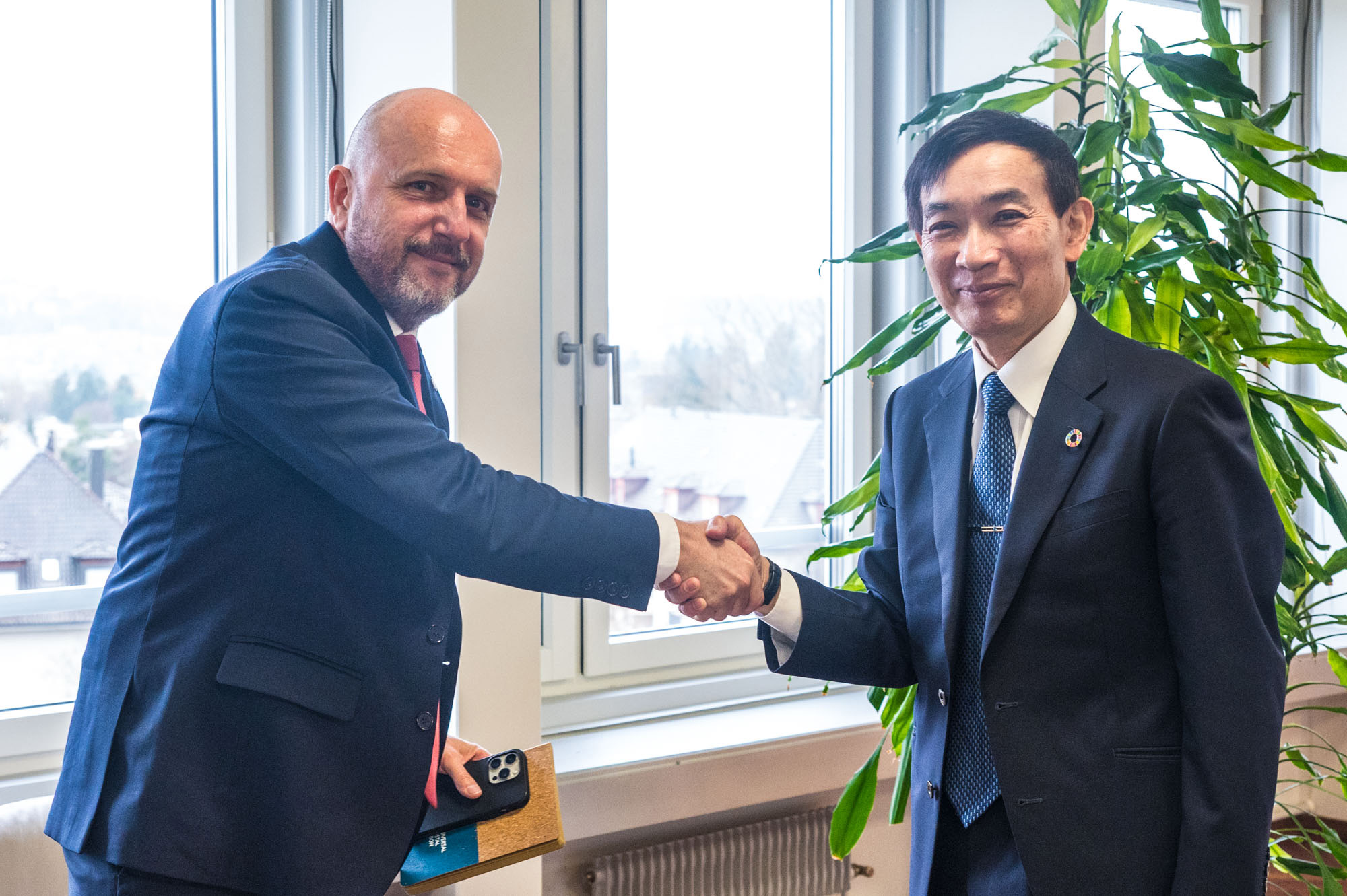
Re-elected at the Dubai Congress held in September, Director General Masahiko Metoki and Deputy Director General Marjan Osvald share their reflections on the UPU’s progress and outline how unity, trust and innovation will guide the organization into its new strategic cycle.
Masahiko Metoki (MM), Director General of the UPU International Bureau
Marjan Osvald (MO), Deputy Director General of the UPU International Bureau
MM: I would like to begin by expressing my heartfelt gratitude to all member countries for the confidence that you have once again placed in me. The Dubai Congress was a defining moment. We entered into it at an important turning point, during a moment of uncertainty for the global economy and the postal sector. Yet, we emerged with renewed determination and a clear vision for the years ahead. Member countries came together to agree on a new strategy and business plan that place the postal network at the centre of social and economic inclusion.
My message is simple: unity must continue to guide our work. Each member country – regardless of size or resources – contributes to the strength of our single postal territory. The decisions that we took in Dubai will now need to be translated into results that people can perceive in their daily lives.
MO: This renewed mandate holds both personal and professional meaning for me. On a personal level, it is a new commitment to my family as we continue our journey for another four years in Berne. Professionally, it is a great privilege to continue serving the international postal community. I truly love this work – it allows me to help others, which has always been one of my guiding principles.
Being re-elected with such strong support is deeply humbling. I see it as recognition of what we have achieved and as a renewed responsibility to continue building on that progress. What touched me most were the many warm wishes that I received – not only from colleagues around the world but also from the staff of the International Bureau. Their encouragement reinforces my belief that our strength lies in collaboration, respect and trust across the entire UPU family.
Reflections on the Abidjan cycle
The Dubai Congress marked the end of an important four-year cycle.
UP: What lessons have you drawn from leading the organization through complex global challenges, from a pandemic to digital transformation?
MM: The past four years have been some of the most demanding in the UPU’s long history. The world has changed rapidly, shaped by a global health crisis, shifting markets and accelerating advances in technology. These changes have affected how people communicate, trade and interact with public services. Through it all, the postal sector has proved its resilience and continued to deliver when societies needed it most.
This experience has reinforced the importance of innovation that serves people, as opposed to technology for its own sake. Guiding the UPU through these challenges has strengthened my conviction that dialogue and trust are our most powerful assets. These values are the foundation of meaningful change. Reform is possible only when everyone is heard and respected.
Resilience also means being ready for what we cannot predict. Natural disasters have become more frequent and severe, threatening operations and livelihoods. The UPU’s work helps member countries to strengthen preparedness and continuity plans, so that essential services can be restored quickly after crises. This approach, which focuses on anticipating rather than simply reacting to crises, will be increasingly important as climate risks grow.
I have also learned that leadership in uncertain times depends on teamwork. The professionalism of the International Bureau staff and the commitment of our member countries have been constant sources of strength. By empowering others and encouraging cooperation, we have been able to keep the UPU agile and responsive to change.
UP: How do you view the UPU’s progress since 2021, particularly in terms of its institutional reform and global outreach?
MO: I can very clearly remember 25 August 2021 in Abidjan, when Metoki-san and I were elected. At that time, the direction and priorities of the Abidjan cycle had already been established by Congress and the previous management. Our task was to carry forward that work with greater consistency, transparency and efficiency.
Since then, I believe that the Union has strengthened both its credibility and visibility. I was especially proud that our 150th anniversary in 2024 helped to raise the UPU’s profile in the international community and renewed awareness of the enduring relevance of the Post.
At the same time, there is still much to do. Digitalization and artificial intelligence are transforming our sector and giving us powerful tools to narrow development gaps between countries. If we do not seize these opportunities, the divide between industrialized and developing nations will only widen. The Dubai Congress has set a clear strategy for the years ahead, and our responsibility now is to turn that vision into results that benefit our members and citizens alike.
Vision and priorities for the Dubai cycle
The Dubai Congress also marks the beginning of a new strategic cycle for the UPU.
UP: What is the overarching vision that you aim to advance through the newly adopted UPU Strategy 2026–2029 and the Dubai Business Plan?
MM: The UPU Strategy 2026–2029 defines the direction of our Union for the next four years. It is built around a clear vision: to create a society that is interconnected, inclusive and enduring, empowered by a seamless and innovative postal network. This vision reflects both continuity and renewal.
Our priorities for the Dubai cycle will focus on three main goals. The first is to strengthen the global postal network through rules-based cooperation that guarantees fairness, transparency and cohesion among member countries. The second goal is to foster innovation and modernization. Postal operators are adapting to new patterns of communication and e-commerce, and the UPU must continue to support them in this journey.
By modernizing operations, improving quality of service and engaging in partnerships, the postal sector can regain its role as a trusted channel for trade and communication. The third goal is to enhance regional cooperation. The UPU’s expanded regional offices have brought the organization closer to its members, allowing us to respond more effectively to local needs.
The Dubai Business Plan translates these ambitions into measurable results. It sets out practical measures, indicators and timelines to track progress and adjust our work to emerging challenges. Ultimately, the strategy and business plan are about empowering every member country to benefit from a network that is modern, inclusive and ready for the future.
UP: Regional engagement and the role of wider postal sector players have grown considerably. How do you plan to sustain this momentum and encourage greater participation from all stakeholders?
MO: Member countries have made it clear that they want the UPU to serve them more directly at regional level. The network of regional offices has expanded since 2022 from seven to 15 worldwide, reflecting growing demand for proximity and support. These offices play an increasingly important role in strengthening the UPU’s presence, improving coordination and assisting members in addressing their regional priorities.
In Dubai, member countries also agreed to rename the “restricted unions” as “regional unions,” a change that highlights their collaborative role in advancing UPU objectives at the regional level. The challenge is to do so efficiently and in a way that remains financially sustainable.
The wider postal ecosystem has also become more important. The Consultative Committee acts as a bridge between the public and private sectors, and its expanding membership brings new perspectives and expertise. These members add real value to the Union’s work by helping us to connect with the innovation taking place in the private sector.
Technology is transforming the entire landscape of delivery. In the future, the distinction between postal and logistics operators will continue to blur. To remain relevant, the UPU must be open to new actors – from fintechs and start‑ups to e‑commerce and digital service providers. Collaboration across this broader delivery ecosystem will be essential to the sector’s success.
UP: On a more personal note, what continues to inspire you about the postal mission and the work of the UPU?
MO: It is hard to believe, but next year will mark 30 years since I joined the postal sector. Over these decades, I have witnessed the sector’s remarkable transformation – from traditional mail to modern logistics and digital communications. This constant evolution, driven by technology and people, continues to inspire me every day.
The postal world has always been about connecting people, but today its role is much broader. What we once called the postal sector has become part of a wider delivery ecosystem that brings together e‑commerce, financial inclusion and even digital government services. This is not only a change in name, but a change in mindset. Posts are now universal delivery networks serving both physical and digital needs.
Few industries have shown such resilience and capacity to reinvent themselves. As e‑commerce expands, so does the need for fast, affordable and sustainable delivery. Posts are uniquely positioned to meet that need, particularly in areas where inclusion and access still matter most.
What motivates me most is the diversity and inclusiveness of this global network. The postal family brings together governments, businesses, communities and individuals, all working towards a common goal – to keep people connected. Living in Switzerland, I see daily how a high-performing postal operator can set a standard of excellence and how this experience can inspire others.
The UPU’s mission is to connect experience and innovation across its membership. Each country has its own strengths, and there is no single model that fits all. What matters is open dialogue and a willingness to share. When member countries express their needs clearly and exchange ideas, we can design solutions together. The strength of the postal world lies in this diversity and cooperation which now extend across the entire delivery sector.
UP: As you begin this new term of office, what message would you like to share with the wider UPU community, including partners and the staff of the International Bureau?
MM: To all members of the UPU community, including our colleagues across member countries and restricted unions, our partners, and the staff of the International Bureau, I extend my sincere thanks. The achievements of the past cycle have been possible only through your dedication, professionalism and teamwork.
As we move forward, my message is one of unity and shared purpose. The UPU’s strength lies not only in its history but in the people who make its work possible. The UPU is at its best when we work as one. Within the International Bureau, I will continue to encourage a culture of openness, creativity and respect where every voice can contribute to innovation. The success of our mission depends on how well we work together and how effectively we translate ideas into tangible progress.
To our partners across the UN system, regional organizations, the private sector and academia, I extend an invitation to strengthen collaboration. The future of the postal sector depends on partnerships that connect knowledge, technology and investment. The coming years will be decisive. With renewed determination and trust, I believe that we can make the UPU an even stronger platform for cooperation and a catalyst for progress in every corner of the world.
MO: Our sector is changing faster than ever, and it is easy to lose sight of what makes the Post unique. At its heart, our mission is simple – to connect people. Communication, listening and dialogue must remain our foundation. I have always believed in open discussion. When I joined the International Bureau, I said that my door would always be open. Some colleagues have taken that opportunity, others less so, but the principle remains the same. Respect, trust and transparency are the basis of good cooperation.
I am convinced that postal and delivery services continue to play a vital role in connecting communities and economies. If I did not believe that, I would not be here. We also need to be more efficient, both within the UPU and as part of the wider UN system. When a member country needs assistance, it should receive it quickly. We must adapt to the pace of our members’ realities.
On a personal level, I was shaped by a postal culture that valued the postal worker as a trusted member of the community. That spirit of public service continues to guide me today. As we enter this new cycle, I hope that we can all work together in good health and peace, with a renewed commitment to serve our member countries and adapt to their evolving needs.
There will be many challenges ahead, both immediate and long-term, but also many opportunities. Our customers remain at the heart of everything we do. Serving them better is the true measure of our success, and I am honoured to continue contributing to the UPU’s growth and transformation in the years to come.
This article first appeared in Union Postale Autumn 2025.