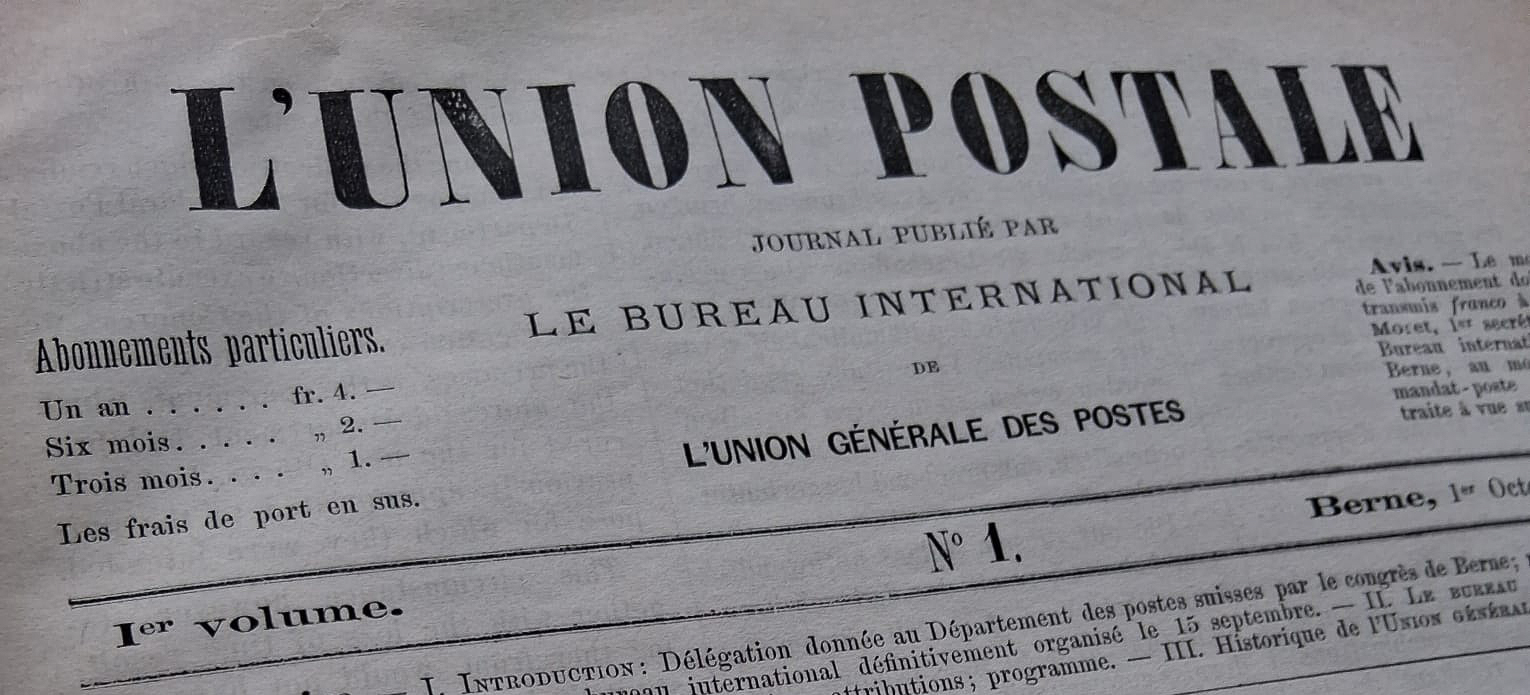
On 9 October 2024, the Universal Postal Union celebrated its 150th anniversary. In 2025, as the International Bureau marked its own 150 years, another cornerstone of the UPU’s institutional history also reached the same milestone: Union Postale, the magazine published without interruption since its first edition in 1875, shortly after the Bureau’s establishment in Berne.
Indeed, since the 1874 Berne Congress, the International Bureau (IB) has been tasked with “preparing, with the help of documents at its disposal, a special journal in the German, English and French languages” [Article XXVII § 9 of the Detailed and Administrative Regulations, 1874] containing “all communications able to enrich the postal service” [Speech of Eugène Borel at the last session of the Berne Congress, 1874].Right from its first edition, printed in 4,000 copies, the flagship magazine of the then-named “General Postal Union” (until 1878) was multilingual. The very first article reproduced in three languages (English, French and German) a speech given by Heinrich von Stephan during the 1874 Berne Congress, at the foundation of the Union: “We keenly may vow, that such a complete unanimity of the governments of the great majority of the civilized nations of the globe constitutes a fact, up to the present unequalled in history!” (L’Union Postale 1875/1). From a monthly publication containing up to five articles and around 20 pages, the format of this journal, sent to all Union members, has changed since its beginning. In 1977, it became bimonthly, and then in 1988, quarterly. Over the years, the number of articles and topics expanded, and new languages were added (Spanish in 1922, and Russian, Arabic and Chinese in 1949) but also removed: the magazine stopped being published in German between 1949 and 1954. In 2017, the German and Russian versions were officially dropped. Over its 150 years of existence, the name was changed only once: in 1951, L’Union Postale became Union Postale.
Of course, Union Postale has always been about all aspects of the postal service: there have been articles about the representation of women among postal employees (“The employment of females in the postal service”, L’Union Postale 1875/15), the inauguration of postal schools – training institutions providing postal workers with professional training, particularly those preparing for managerial roles (“Opening of the National Posts and Telecommunications Institute of the Malagasy Republic”, Union Postale 1968/10), and new postal technologies (“Automatic parcel-acceptance machines”, Union Postale 1981/2).
The magazine has also published reports of Congress, information concerning senior officials of Posts and the International Bureau, lists of publications received by the IB, additions to the film library catalogue, and details about stamps sent for the UPU collection, in addition to obituaries of former Directors General and staff members who died in the course of their service. While making room for lighthearted text and humorous cartoons, Union Postale has also served to highlight substantive and strategic issues shaping the future of the postal sector, whether it be through an article outlining a problem to be addressed, or through solutions proposed in subsequent issues, or editorial commentaries engaging with previously published articles. As a space for debate and for exchange, Union Postale has, over the years, explored all facets of the postal world and its history.
Since its beginning, the magazine has accepted and published articles on a wide range of topics from a variety of contributors: from IB staff members, to postal experts reporting on their missions, to postal employees sharing their challenges or describing their day-to-day work. Over time, the publication has also evolved in step with technological developments, with its format – including its online platform – adapting accordingly. Photographs gradually started appearing in the 1920s and by the 1960s were an integral part of the magazine, along with building plans, organizational charts and postal emblems.
A vital testament to the International Bureau’s role in connecting Union members, the magazine is more than a conduit for circulars and letters to postal administrations. Between its pages are innumerable reports and accounts – sometimes spanning several issues – providing a composite picture of postal operations within UPU member countries. Mail delivery by kayak in Greenland (L’Union Postale 1877/10), postal training in Africa in the 1960s (Union Postale 1966/3), and postal services operating on Sundays in Latvia (L’Union Postale 1924/5) are among the many snapshots of postal services over the past 150 years. However, beyond their purely factual nature, these articles serve as a reminder that Union Postale has always supported the IB’s primary mandate – to connect Union members, by keeping them apprised of postal developments around the world and by reporting on innovations being explored. The information thus benefits all members, supporting their progress and decisions.
Although current content is more likely to focus on generative AI and the global economy than on earlier postal innovations such as pneumatic tube mail systems or zeppelin-borne air mail transport, Union Postale continues to fulfil its mandate by informing readers about developments in the postal sector in five languages. Today the magazine is joined by the Digital Union monthly newsletter, Voice Mail podcast and Postal Matters blog.
This article first appeared in Union Postale Winter 2025/2026.