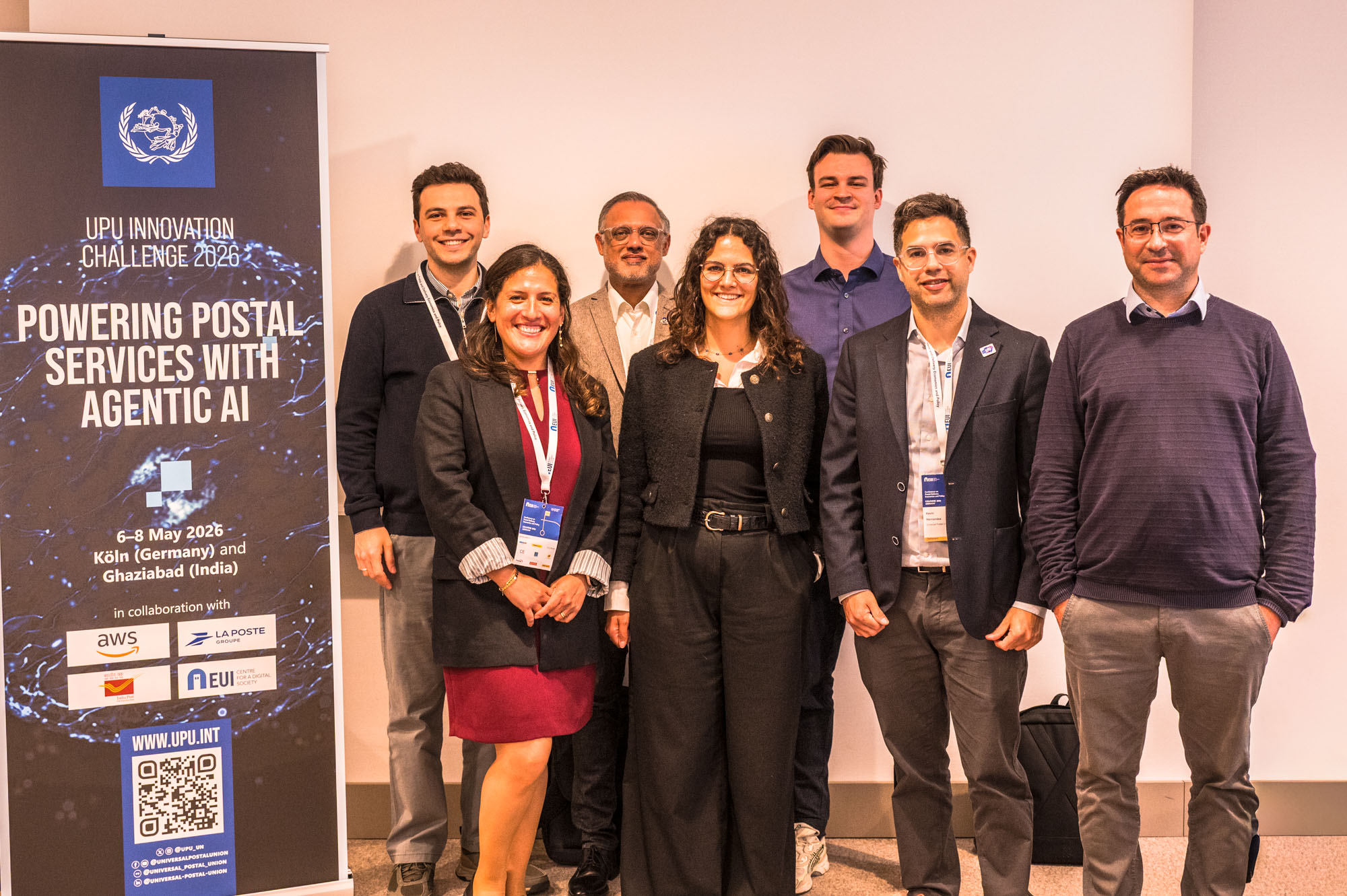
The fourth UPU Innovation Challenge was the first to be held in two locations simultaneously – Köln in Germany and Ghaziabad in India – bringing together postal experts, economists, regulators and artificial intelligence (AI) developers to explore a deceptively simple question: what happens when postal networks stop behaving like isolated services and start operating like intelligent, coordinated systems?
Over three intensive days, teams worked across eight AI-focused challenges ranging from disaster resilience and financial inclusion to regulatory diagnostics, adaptive delivery networks and historical archives.At first glance, some of the concepts sounded experimental: multi-agent systems, orchestration layers, AI-assisted corridor strategy and dynamic policy advisory platforms. But underneath the technical vocabulary was something more structural; the postal sector is beginning to reconsider itself not simply as a delivery network, but as coordination infrastructure.
Underpinning the entire Innovation Challenge was the newly introduced postal services orchestration canvas – a framework spanning strategy, operations and governance. Rather than treating mail, parcels, financial services and digital systems as separate verticals, the model reframed postal networks as orchestrated ecosystems where infrastructure, data, logistics, regulation and public services continuously interact.
Many of the projects explored exactly that transition across eight challenge areas.
One of the most prominent – Challenge 1: Rapid community resilience service toolkits – focused on how postal networks could function during climate disruptions not only as delivery systems, but as emergency infrastructure capable of supporting communications, medicine distribution, beneficiary verification and emergency cash transfers.
One operational reality quickly became clear: disasters break information flows first. Roads become inaccessible. Communications collapse. Data becomes fragmented precisely when decisions need to be accelerated. In response, participants proposed systems whereby postal workers, local branches and delivery networks become real-time intelligence nodes feeding information into AI-assisted operational dashboards.
One proposal explored how postal workers could submit voice reports directly from disaster zones, allowing AI systems to extract operational intelligence even when communications infrastructure is degraded. Another imagined postal branches functioning as emergency connectivity hubs, offering satellite communications, emergency Wi-Fi, medicine storage and digital access points after hurricanes and floods.
The logic was pragmatic. Postal networks already possess nationwide reach, trusted local presence and physical continuity. Participants repeatedly emphasized that postal networks can play a broader role beyond logistics by supporting governments, non-governmental organizations and private donors during disasters through coordination and service continuity, particularly in reaching vulnerable and remote communities.
Many of the proposals also focused on using the postal network’s “feet on the street” as an asset for real-time ground verification and local operational intelligence during emergencies. The challenge is no longer whether infrastructure exists, but whether it can coordinate dynamically under pressure.
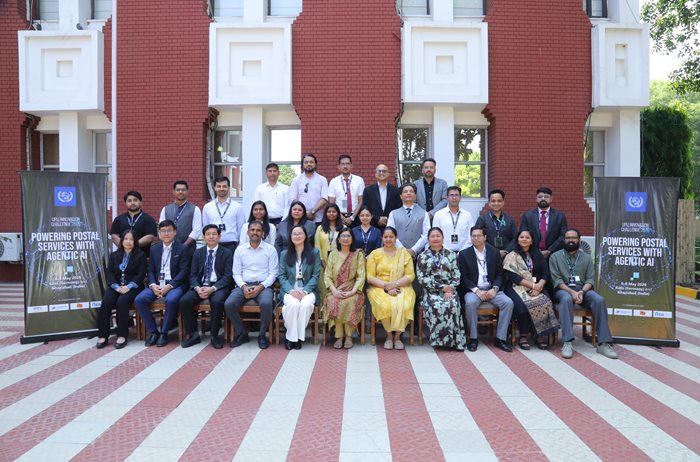
That same orchestration mindset appeared across multiple challenges.
The team initially working on Challenge 6: AI for postal policy advisory and implementation support realized that integrating elements of Challenge 3: AI advisory platform for postal financial services could strengthen the model. The merged approach explored how AI-driven advisory systems could help governments assess financial inclusion readiness, benchmark postal financial services and translate policy ambitions into operational pathways.
Rather than treating policy documents, postal data and financial inclusion indicators as isolated information pools, the proposals envisioned evolving advisory systems capable of connecting regulation, infrastructure and operational realities in real time.
Participants working on Challenge 4: Adaptive design of last-mile delivery networks explored how multi-agent systems could redesign delivery models across urban, peri-urban and rural environments based on infrastructure, geography and demand fluctuations.
Meanwhile, Challenge 5: AI-powered intention economy platform questioned whether Posts could evolve into trusted intermediaries for AI-driven commerce, whereby intelligent agents negotiate directly with sellers on behalf of consumers.
Instead of platforms competing for attention through surveillance and advertising, participants explored systems where consumers explicitly declare intent while AI agents negotiate transparently around demand. In that model, the Post becomes less a delivery operator and more a trusted coordination layer for digital commerce.
Some concepts were highly operational. Others were philosophical. But together they revealed a larger pattern. The postal sector is no longer thinking only about moving objects. It is beginning to think about coordinating systems.
Perhaps the most intellectually provocative project came from an unexpected direction: the UPU archives.
The team working on Challenge 2: Intelligent valorization of UPU historical archives experimented with agentic AI systems capable of navigating 150 years of UPU Congress documents, photographs and institutional records to reveal historical trajectories and policy patterns.
The project proposed that institutional archives are not static repositories, but latent intelligence systems. Using agentic AI, the team explored whether historical decisions, debates and regulatory trajectories could be reconstructed and opened to dynamic exploration in ways previously impossible.
The presentation framed the archives as an institution “thinking out loud” across 150 years of postal history.
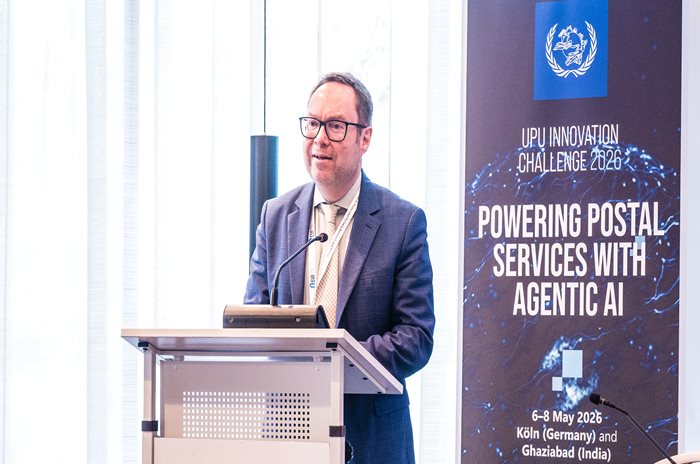
Ultimately, this Innovation Challenge was not only about AI tools even if it used some recent frontier agentic AI develpments. It was also about institutional cognition. How does a global network remember? How does it coordinate? How does it adapt?
Postal systems are uniquely positioned for this transition because they already sit at the intersection of physical infrastructure, identity, trust, regulation and national reach. What has historically been missing is not presence, but orchestration.
Agentic AI, in this context, was presented less as automation and more as connective tissue.
The team involved in Challenge 7: AI for postal regulatory diagnostics and reform explored how AI could support countries in identifying regulatory gaps and designing sequenced postal reform pathways, while participants in Challenge 8: AI for universality diagnostics and postal corridor strategy examined how AI models could diagnose a country’s structural position within the global postal network and propose corridor strategies to strengthen participation and connectivity.
One of the strongest themes throughout the event was resilience. This was particularly evident in discussions around universality and network inequality, during which participants examined how international postal flows are increasingly concentrating into asymmetric corridors, leaving some countries structurally peripheral.
Of course, many of these prototypes remain conceptual. Several teams openly acknowledged technical limitations and unfinished architectures. But the significance of the Innovation Challenge was strategic.
It offered a glimpse into how the postal sector may begin redefining itself in the AI era, not merely as a logistics industry, but as a form of societal infrastructure capable of coordinating information, trust, delivery, resilience and public services simultaneously. For over a century, postal systems connected places. The next phase may be about connecting systems themselves.