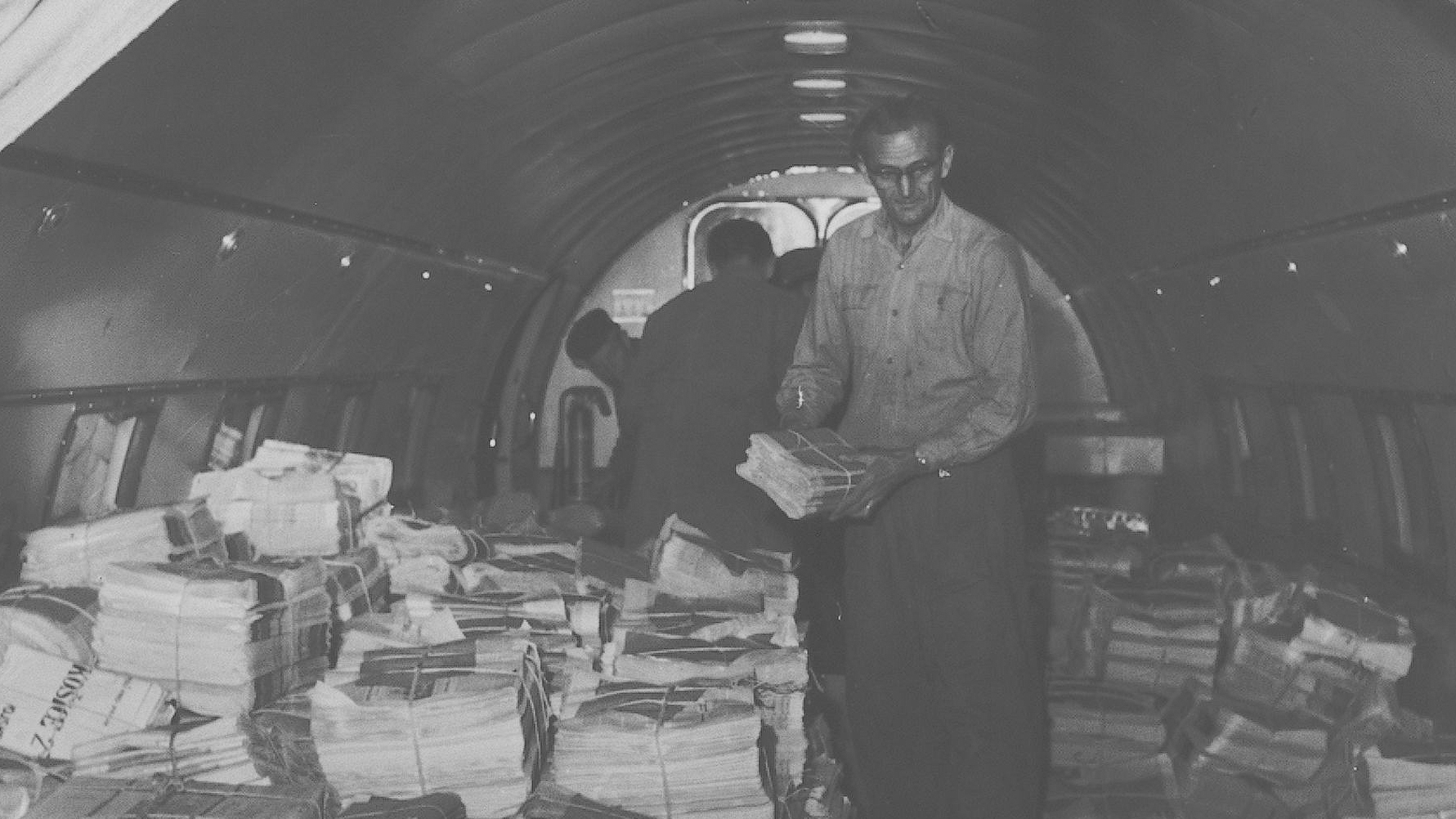
Airmail emerged as aviation opened new possibilities for connecting people across long distances. As aircraft began to demonstrate their potential for carrying mail quickly and reliably, the UPU worked to help postal administrations adapt to this new mode of transport. The development of airmail soon became an important part of the wider evolution of international postal services, tracing a path from early experimental flights to the establishment of global air routes.
From the moment the first air routes began to emerge, mail quickly found its place on board. The airplane, a symbol of modern transport, offered a way of conveying postal items more rapidly and with increasing reliability, and soon became the preferred option for express services.Early regulation of airmail
What started off as small initiatives in the early 20th century, steadily expanded from the 1920s, first at the national level and later at the international and intercontinental levels. The evolution from early propeller aircraft crossing the English Channel to today’s jet aircraft linking New York and Johannesburg reflects a transformation in which the UPU played an early role by helping postal administrations address the emerging challenges of airmail and by developing the first international provisions governing its use.
A major step forward came in 1927, the year of Charles Lindbergh’s first solo transatlantic flight, when the first airmail conference took place in The Hague. It marked the first occasion on which postal administrations addressed the specific requirements of airmail within the framework of a postal convention. The conference introduced a number of important provisions. These included guaranteeing freedom of transit for air-transmitted letters and parcels within Union countries and territories, requiring countries to forward mail even when national air routes were not available, establishing airmail surcharges, and defining remuneration for airlines responsible for carrying mail by air.
Growth of global routes
As aviation technology developed, the scope of airmail expanded significantly. New long-distance services, such as the South Atlantic route between France and South America pioneered by Jean Mermoz and Antoine de Saint-Exupéry, and the Empire Air Mail Scheme linking the United Kingdom of Great Britain and Northern Ireland to Australia from 1938, strengthened the role of air transport in postal operations.
Until the 1952 Brussels Congress, airmail services were divided into “ordinary” and “extraordinary” categories, each requiring different surcharges. As a result of cooperation between the International Air Transport Association (IATA) and the UPU’s Executive and Liaison Committee (ELC) [1], these categories were replaced by a single surcharge system adapted to the type of item. The Congress also simplified the calculation of transport charges through the adoption of an official list of airmail distances and a method based on the actual weight of mail carried. Aerogrammes [2] were regulated for the first time during this Congress.
The introduction of jet aircraft in 1958 accelerated developments already under way. Jets provided lower operating costs, greater payload capacity and considerably higher speeds. As a result, airmail volumes steadily grew: 130 million tonne-kilometres in 1945, 610 million in 1960, 2.3 billion in 1968 and 6.8 billion in 2019.
The late 1960s also marked a period of strong institutional engagement in the development of airmail by the UPU. Following the retirement of Dr Eduard Weber, the UPU International Bureau was led by Dr Michel Rahi, who was elected Director General in 1966. His long-standing interest in airmail, reflected in his doctoral research on the subject and its associated transport costs, helped reinforce the Union’s focus on the evolving requirements of air transport during a period of rapid expansion in global aviation.
[1] The Executive and Liaison Committee (ELC), established by the 1947 Paris Congress, became the Executive Council (EC) in 1964 and later the Council of Administration (CA) in 1994.
[2] Aerogrammes are lightweight letter sheets designed to fold into their own envelope, allowing postal operators to reduce the weight and cost of items sent by air.
[UPU Archives – Czechoslovakia, 1969]