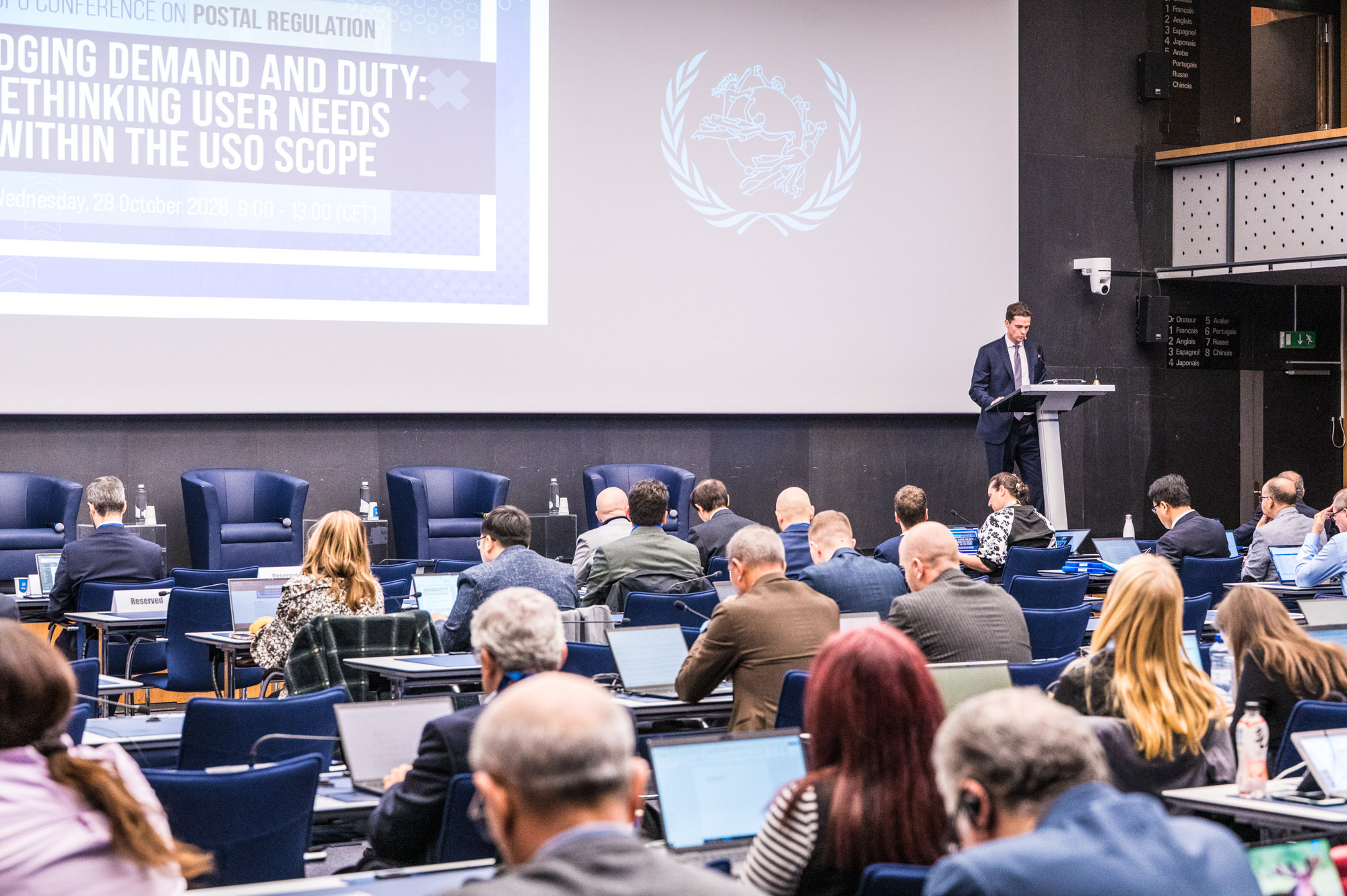
The Universal Postal Union (UPU) held its biannual Conference on Postal Regulation on 28 October 2026, during the autumn session of its Council of Administration. The theme was “Bridging demand and duty: rethinking user needs within the USO scope”.
The programme aimed to support informed regulatory decisions, so that postal universal service obligations (USOs) meet user needs while staying financially sustainable.In his opening address, UPU Director General Masahiko Metoki noted that declining mail volumes, changing markets and evolving user expectations were “widening the gap” between the scope and the financial sustainability of the USO in many countries.
“As policymakers consider changes to service standards, affordability, access and delivery frequency, it is essential that users’ experiences and priorities inform those choices. Listening to users should be central to designing the universal postal service obligations, not an afterthought,” said the Director General.
The USO paradox
In his keynote, Mindaugas Cerpickis, a partner at consulting firm Copenhagen Economics, highlighted a key paradox facing the USO: postal economics run on scale, but that scale is running in reverse. Network costs are rising while letter volumes fall fast. Meanwhile, the Post’s social value is declining because operators are tied to legacy services and lack the resources and mandate to meet today’s customer needs.
Cutting delivery speed or frequency can ease some of the financial burden, but only up to a point. Governments have two options: finance the USO or give postal operators more flexibility.
“Reform is not only about cutting back but also about deciding what to build,” said Cerpickis, adding that any development must be built on real customer needs, with the USO designed to address the gap between those needs and what the market fails to provide.
Needs vs wants
The first panel set out to define practical approaches for measuring those needs.
Fergal Farragher, Policy Director at Ofcom, the UK postal regulator, and Özhan Zurel, Head of the Postal Market Department at the Belgian Institute for Postal Services and Telecommunications, shared their countries’ approaches. Both stressed the need to separate real needs from wants or preferences.
Farragher explained that Ofcom used a MaxDiff model to see how respondents weighed trade-offs between service elements. Letters remained vital, but customers cared more about loss, damage and security than delivery speed. This led to reforms of delivery frequency, quality-of-service standards for some mail classes, and access obligations.
Zurel explained that the Belgian regulator combined survey methods. Qualitative surveys captured customers’ experiences, perceptions and expectations. Quantitative analysis measured their behaviour, satisfaction and needs, based on how they reacted to different service scenarios and cost expectations.
The analysis yielded some surprising results. For example, while postal operators tend to prioritize fast delivery, customers were willing to accept slightly slower delivery. For letters, home delivery was essential; for parcels, pick-up points near home are increasingly becoming an acceptable alternative.
Both speakers agreed this research should be repeated regularly to identify gaps between supply and demand.
“Don’t shrink the USO, sweat it”
The second panel brought together policymakers and regulators from India, Zimbabwe and Denmark to explore policy options for sustaining the universal postal service.
Shri Subrat Das, Secretary of India’s Department of Posts, said policymakers see the postal network as essential infrastructure for a wide range of services, from finance to digital and beyond. That breadth is what makes it economically viable.
“Reach is a national asset, and reach has positive externality for the system,” he said. “Anyone wanting to use the whole market of India can use this network.”
Kennedy Dewera, Director of the Universal Service Fund at Zimbabwe’s Postal and Telecommunications Regulatory Authority, agreed.
“The same asset that we sit on today is the same asset fintech companies are spending billions to construct,” he said. He advised regulators to persuade governments to “sweat” the network built under the USO, through flexibility, funding and a push for innovation.
In Zimbabwe, the Post already works with the ministries of transport, finance and environment. This partnership role secures funding for the operator and helps governments meet policy objectives. Zimpost, the national postal operator, draws on the country’s Universal Service Fund, which receives contributions from the telecoms sector, private operators and the Post. Using it, Zimpost has opened 147 digital centres in post offices, 32 stand-alone brick-and-mortar centres and 24 converted containers in rural areas that offer digital services and training.
Denmark recently removed the USO altogether, keeping regulation only for international mail, services for blind people and the needs of small islands. Peter Hilmer Fuglsang-Damgaard, Head of the Corporate and Preparedness Division at the Danish Ministry of Transport, explained how targeted measures protected the universal service while halving the need for state aid.
This required stronger market monitoring to keep services available nationwide. Steep volume declines forced price increases, but quality of service stayed high.
Future orientation
In closing, UPU Deputy Director General Marjan Osvald said that while the postal network’s purpose remains relevant, the infrastructure and regulatory models that deliver it must evolve with customer needs.
He added that the UPU’s 2026–2029 strategy sets the framework for this evolution. It enables the organization to support countries through modern policy guidance, common standards, interoperability, innovation and stronger cooperation across the wider postal ecosystem.
“Our relevance will be determined not only by what we preserve from our past, but by what we enable for the future,” he said.