How a four-year partnership took on-time performance from ~50% to 95%
As a member of the UPU Consultative Committee, FarEye is working with postal operators to address some of the operational challenges reshaping the sector. FarEye’s partnership with Pos Malaysia offers one example of how technology and collaboration between the wider postal sector and designated operators can support this transformation.
Pos Malaysia's turnaround over the past four years offers a compelling case study on what happens when a designated operator treats a delivery crisis as a tooling problem first, and a people problem second. FarEye is a bronze member of the UPU Consultative Committee, which brings together postal-sector stakeholders from across the UPU community and gives operators a forum for comparing notes on exactly this kind of transformation. Pos Malaysia's experience with delivery management provider FarEye offers other members a concrete reference point for improving performance.
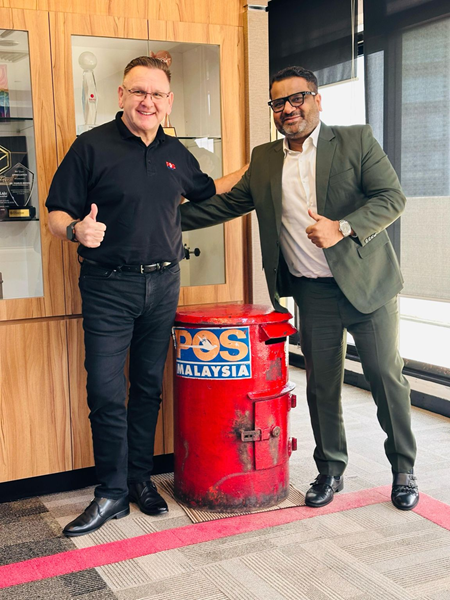
In the frame: Charles Brewer, Group Chief Executive Officer at Pos Malaysia Berhad with Gautam Kumar, COO & Co-founder of FarEye - celebrating a shared vision for future-ready postal systems across the globe.
How it started
When Charles Brewer became Group CEO of Pos Malaysia in August 2021, the board's brief came with a familiar phrase attached: digital transformation. At that point, on-time performance for mail and parcels sat at around 51 and 57 per cent, respectively, one shipment in two. The technology estate explained much of it. The systems were largely on-premise, there was no cloud transport management, no connection between operations and SAP, and no system measuring how likely customers are to recommend the service to someone else at all, which meant no instrumented view of what customers were actually experiencing. Four years later, Pos Malaysia ran parcels at 92 per cent on time and mail at 95 per cent.
A change programme before a technology programme
Getting there meant replacing the ageing tooling with a new system. Pos Malaysia brought in FarEye's AI-powered delivery management platform, spanning the first, mid and last mile, and moved around 10,000 postmen and couriers onto it. Brewer is candid that this produced real resistance early on, and that the response was to return to the why repeatedly rather than announce it once. Pos Malaysia treats courier sentiment as an output of the programme in its own right, running regular surveys on the tools themselves; the most recent put satisfaction at roughly nine in ten.
The cost squeeze was answered with capacity instead of headcount. Last-mile productivity moved from around 35 to around 90 parcels per courier per day, a 150 per cent increase through route orchestration, automated pickup assignment and automated scheduling upstream. The impact of transformation was seen even on returns: every returned item previously had to be scanned individually to its own destination across facilities nationwide. Items are now bagged to a consolidation point, with allocation handled downstream, a large recurring labour cost removed that no customer ever sees. Combining telematics with delivery data also made driver behaviour visible in advance rather than after an incident; safety events have fallen by around 20 per cent year on year.
Only then did the experience layer start paying off. Delivery Net Promoter Score (NPS, a customer satisfaction metric) has moved from roughly 56.7 to 78.5 thanks to WhatsApp updates along the journey, real-time tracking, instant digital proof of delivery, and, in a high cash-on-delivery market, telling customers in advance what amount to prepare, plus in-app QR payment so COD can be settled digitally at the door. The courier doing the delivery didn't change; only the information and tools available to them at the point of delivery.
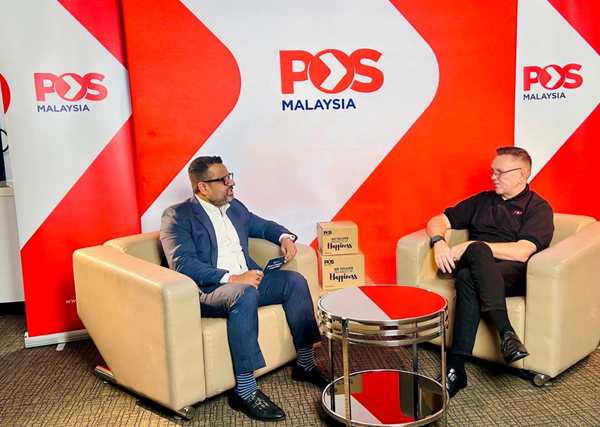
Charles Brewer of Pos Malaysia in conversation with Gautam Kumar, Co-Founder at FarEye, reflecting on how they worked together to make their aspirations a reality. FarEye’s platform has been instrumental in orchestrating Pos Malaysia’s complex logistics network with greater intelligence, enabling the service to handle higher volumes, maintain full operational visibility, and serve customers all while lowering the unit cost of delivery.
Lessons for other postal operators
Pos Malaysia's experience points to a few lessons for UPU Consultative Committee members and operators:
- Diagnose the tooling before diagnosing the workforce. Chronic on-time failure is often a capability gap that gets misread as a people problem. Ruling out the former first can save years of misdirected effort.
- Track front-line sentiment as a KPI, not an afterthought. Surveying couriers on the tools themselves, alongside on-time performance and cost per delivery, surfaces resistance early rather than letting it compound.
- Look for the invisible process costs. Returns sortation, bagging and manual scanning are customer-invisible work, and often carry the fastest payback and the least organisational friction to fix.
- Plan for the resistance phase. Large-scale migrations are typically decided during roll-out, not at procurement, and need close cooperation between the operator and its technology partner