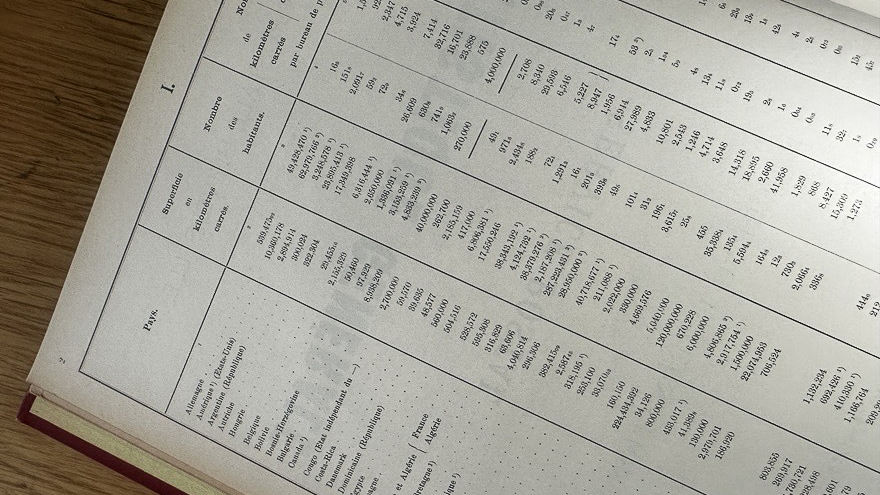
The Universal Postal Union (UPU) is marking 150 years of “Postal Statistics” at a time when reliable, comparable and transparent data is essential for postal development worldwide. Since the earliest years of the Union, statistical evidence has shaped major policy decisions.
The origins of this longstanding statistical system can be traced back to the broader development of international official statistics in the 19th century, shaped by figures such as Adolphe Quetelet – a Belgian statistician who convened the first international congress of statisticians in 1853 – and Karl Pearson, a British mathematician whose work laid key foundations for modern data analysis. Their contributions helped establish the principles of rigour and comparability that underpin official statistics today. It was in this context that the UPU began collecting data in 1875. “They focused simply on knowing what was happening in terms of postal services within and between member countries,” explains Vincent Schicker, UPU Historian, noting that this clarity was essential for discussions on fees, major routes and the emergence of new transport methods such as railways and airmail.“By 1886, statistics included postal workers by category, the number and coverage of post offices, the total distance of routes by rail, road and water, the kilometres travelled by postal staff, even the number of horses and carriages, as well as the financial results of postal operations,” Schicker adds. As reporting expanded, it also recorded postal equipment such as machines that print postage, sorting machines and mailboxes. Such detail, he adds, helped countries identify weaknesses in staffing or infrastructure and encouraged them to turn to the UPU for cooperation and technical support.
This early commitment to statistical evidence soon proved essential. UPU data revealed growing imbalances in international mail flows, which led to the introduction of the terminal dues system. As UPU expert on postal statistics, Lukasz Piotrowski notes that this reform “would not have been possible without producing statistics,” underlining how harmonized data has shaped the evolution of the global postal network since its earliest decades.
Today, “Postal Statistics” continues to underpin major UPU analytical products, including the Integrated Index for Postal Development (2IPD). Member countries draw on the annual figures to benchmark performance, evaluate reforms and strengthen national postal networks.
Continued importance in an age of big data
The growth of big data has expanded the range of information available to postal operators, but it has also heightened the need for trusted, transparent sources. Piotrowski emphasizes that the foundation of postal statistics is increasingly important in a rapidly changing information environment. He observes that “in an era of spreading misinformation, misinterpretation, self-proclaimed expertise and opaque data sources,” official and verifiable statistics are indispensable for both national and international decision making.
José Anson, UPU Economist, highlights the inclusion of UPU statistics in the United Nations statistical system, following the Union’s entry into the UN in 1948, as a major milestone in the evolution of postal statistics. “It marked an important recognition of the postal sector within global statistics,” he says. UPU postal statistics have ensured that the sector is reflected within the UN statistical system guided by the UN Fundamental Principles of Official Statistics. These principles underline that “statistics must be relevant and impartial, produced through professional and scientifically sound methods free from political influence, and supported by clear accountability and transparency,” explains Piotrowski.
The UPU shapes its statistical framework under its Constitution, which calls on member countries to share the data needed by the Union. This cooperation enables the International Bureau to maintain a comprehensive and reliable global dataset.
At the same time, Piotrowski stresses that “these principles do not prevent innovation.” He adds, “Alternative data sources, including big data, may complement official statistics when their use is transparent and methodologically sound.”
Strengthening comparability across 192 countries
Ensuring consistency across different national postal systems remains a complex undertaking. The diversity of postal products and service models makes full standardization impossible. Piotrowski points out that a “domestic parcel” may refer to very different services depending on the country, while the term “post office” may describe anything from a fully equipped permanent branch to an access point located in a village shop.
Questions also arise when attempting to define and measure access to postal services, particularly when calculating the share of the population that benefits from it. These examples, he notes, show “why complete standardization is not possible, but maximum comparability must always be the goal.”
Next year, the UPU will launch a reform of its “Postal Statistics” publication under a dedicated working group. New indicators linked to sustainability and digital services are expected to be introduced. According to Piotrowski, “the greatest challenge will be to broaden the scope of postal statistics in order to collect data on the whole market, not only on postal operators.”
He outlines that expanding coverage requires careful consideration, noting that the reform “must balance feasibility, continuity of data series, consistency and inclusiveness,” so that the updated system remains practical for all member countries while still capturing a more complete picture of the postal sector.
[UPU Archives – UPU Postal Statistics, 1875]