The UPU Delivered Duty Paid (DDP) solution enables Posts to collect duties and taxes at origin, improving customs clearance efficiency and providing full landed cost transparency to customers.
The solution is available through CDS and APIs and supports integration with certified third-party providers.
As of 18 February 2026, the following third-party providers are integrated with the UPU DDP solution.
Zonos
International Bridge DBA SafePackage LLC
iCustoms c/o Clear Customs Group Ltd
Truckersfinder Inc. c/o DutyIQ
BoxC Logistics, Inc.
UPU Delivered Duty Paid (DDP) is a product:
- • for the shipping of goods
- • that are subject to taxes and duties at destination
- • and for which the taxes and duties are collected at origin (before shipment).
The UPU DDP provides 3 integrated options for the payment:
- Pay at Post (Post of origin collects the taxes and duties for the country of destination).
This is the typical model for Over The Counter (OTC) transactions with retail postal customers. - Pay directly the 3rd party provider.
Here again this targets the retail customers and it is particularly adapted when the post of origin cannot collect taxes and duties for a destination country. In that case a payment solution is directly provided by the 3rd party (for example: mobile App or payment link to a trusted payment platform) and the CDS is informed of the payment status prior to collecting the mail item for shipment. - Pay on invoice the 3rd party provider.
Similar to the previous option, however the payment on invoices targets the business customers (typically: eCommerce platforms). Those type of trusted accounts can be registered at the 3rd party provider and be invoiced at regular intervals for their shipments. Likewise, the CDS software is informed of the payment status prior to collecting the prepared shipments.
General DDP considerations:
DDP (an international commercial term, or Incoterm) is particularly suited to e‑commerce shipments by Posts. It is designed to accelerate customs clearance at destination and, for a customer buying online, DDP means that all relevant information (full shipping costs including postal delivery and taxes and duties) is available at the time of purchase.
However, DDP entails additional tasks and responsibilities for the origin Post. Specifically, the origin Post must inform the shipper of the applicable taxes and duties, collect the corresponding amounts and transfer these amounts to the customs authority at destination.
To help designated operators adopt this model quickly, the UPU’s Postal Technology Centre (PTC) is rolling out a DDP solution that leverages existing UPU technologies and services:
- • For data flows, the Customs Declaration System (CDS) and POST*Net are at the core of the solution. UPU DDP APIs are also available for non-CDS users, through the PTC API Gateway;
-
- • For financial flows and international settlement, it is envisaged that UPU*Clearing will be used. This part of the solution will follow at a later stage, pending approval by the UPU*Clearing User Group.
The various sections on this page provide updates on the different components of the UPU DDP solution.
Please refer to the DDP Implementation Guide for guidance and to prepare for roll-out of the solution and IT integration.
Key features of UPU DDP
All versions (CDS.post, Cloud, local instances) and via all interfaces (CDS UI, Kiosk, EAD Customs Declarations (mobile application) and CDS.API)
The solution is accessible to any Post via APIs.
Settlement and EAD features
To follow at a later stage through UPU*Clearing
- Harmonized System (HS) codes: look-up or verification checks
- Prohibitions and restrictions checks
- Denied parties checks
- UPU SAVE
Label/S10 and licence
- S10 is unknown at the time when landed cost calculations (LCC) are conducted. UPU DDP uses a declaration ID – a temporary ID for tracking the draft declaration and associated landed costs until the mail item label/S10 is created
- S10 is known at the time of LCC. This is typically the case when the shipper is provided with S10 ranges by the origin Post. In this case, UPU DDP still uses a declaration ID as above, but the associated S10–declaration ID is created immediately after LCC.
For US-bound flows
UPU DDP can be powered by any QP
Each origin Post can select its QP
An origin Post can decide to use more than one QP
(from CDS 2025 SP1 onwards)
This is made possible with coding in ITMATT to specify which QP is used for the mail item.
Data copied from POST*Net to the QP
Only the data required for the CBP filing is uploaded to the QP; no personally identifiable information is copied. For the filing, the item ID (S10), declared value and country of origin, as well as the transport information, are provided.
Copies are activated upon formal authorization by the Post.
UPU DDP – Guided Flow in CDS Kiosk and CDS Web interfaces
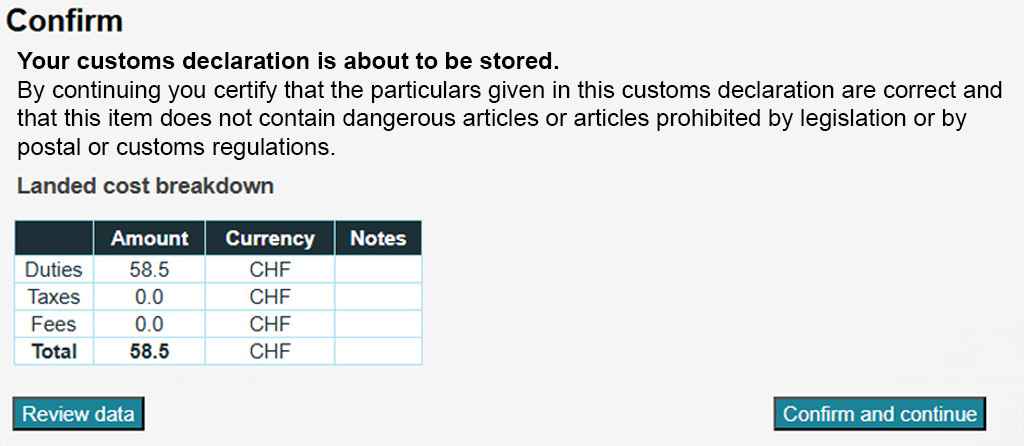
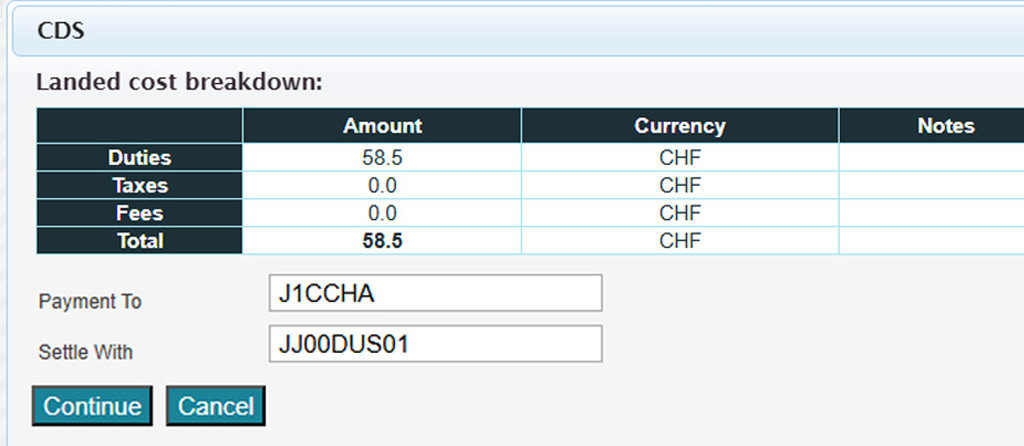
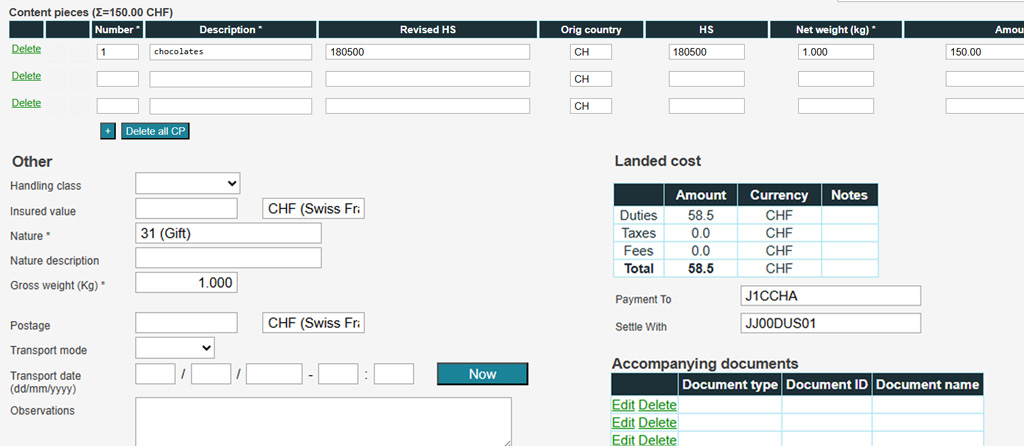
The screenshots below show the CDS Kiosk and CDS Web interfaces, updated to support Delivered Duty Paid (DDP).
They include automatic duty and tax calculation and display the full landed cost to users.
1. Customs data entry (CDS Kiosk interface)
The operator enters content details (description, weight, value, HS code). This data is used to automatically calculate applicable duties and taxes.
2. Landed cost breakdown
Based on the declared information, the system calculates duties, taxes, and fees.
3. Final cost summary and settlement details
The system displays the final landed cost along with settlement identifiers. The customs declaration can then be converted into an ITMATT message.
Features and project updates
Some components of the UPU DDP solution are ready. This section provides the status of each component and will be regularly updated by the PTC. For information to select the components that are right for you, as well as guidelines for implementation, please refer to the UPU DDP Implementation Guide available below.
APIs on the PTC API Gateway
CDS solution
- Existing APIs that can now be used with any provider:
- CalculateLandedCost
- LinkS10ID
- QueryDeclaration
- CreateManifest
- GetExternalDeclaration (to return declaration data (and landed cost information, if available) from an external provider
- ConvertExternalToCDSDeclaration (to validate and convert the external declaration into a CDS declaration)
- Data copies to US qualified parties
Data copies to US qualified parties
For the procedure to authorize data copies, see section of the DDP Implementation Guide.
Financial settlement solution
- For direct invoicing by the QP: see section of the DDP Implementation Guide
- For invoicing through UPU*Clearing: updates to be provided at a later stage